Description
You manage thousands of physical IT assets across laptops, desktops, servers, network devices, and peripherals, yet visibility is often fragmented across spreadsheets, tools, and teams. Assets go missing, refresh cycles drift, disposals are poorly documented, and audit requests expose gaps in ownership, location, and control. Finance questions asset values and depreciation assumptions, Security worries about data exposure on returned or lost devices, and IT struggles to enforce consistency across regions and suppliers. Without clear hardware asset processes, cost, risk, and compliance issues multiply quietly in the background.
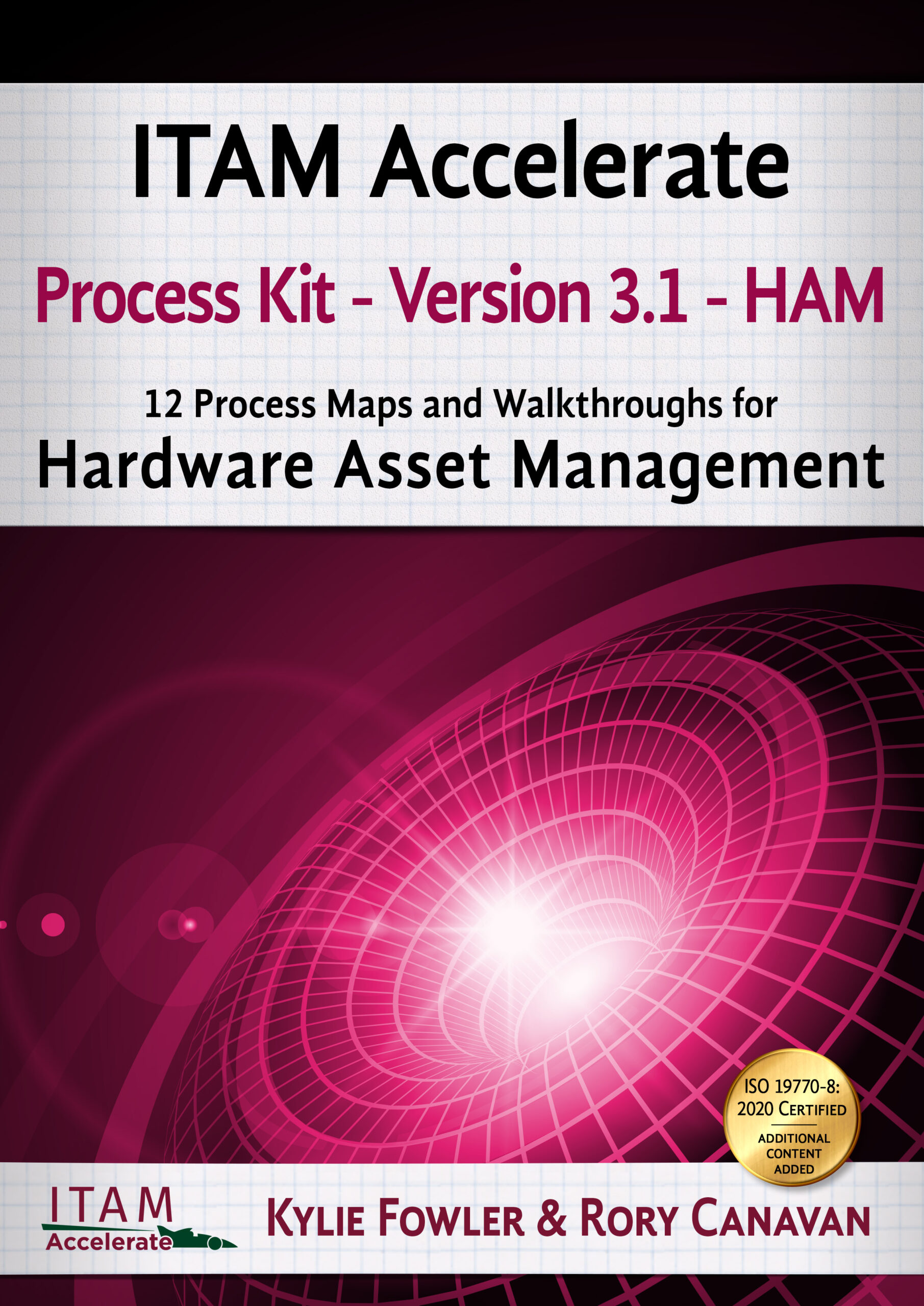
The ITAM Accelerate HAM Process Kit provides ISO‑19770-1 aligned, end‑to‑end hardware asset management processes that bring structure, accountability, and auditability to the full hardware lifecycle. Covering request, procurement, deployment, support, and disposal, the kit enables accurate asset records, controlled change, and defensible audit evidence. These processes help you reduce asset loss and waste, support financial and regulatory audits, minimise security and data‑removal risk, and ensure hardware assets deliver maximum value throughout their usable life.
Fully modelled and customisable, the HAM Process Kit enables consistent, repeatable control of hardware assets across IT, Finance, Security, and the wider business.
What's Inside
01 | GETTING STARTED
| Topic |
Page |
| About the Authors |
6 |
| Acknowledgements |
7 |
| What’s New? |
8 |
| Introduction |
10 |
| Introducing ARIS |
11 |
| Why is Hardware Asset Management Important? |
14 |
| What is a Hardware Asset? |
14 |
| IT Asset Register vs Configuration Management Database (CMDB) |
17 |
| Prioritising Your Hardware Asset Management Processes |
19 |
| Process Summaries |
21 |
02 | HARDWARE ASSET MANAGEMENT PROCESSES
12 comprehensive Hardware Asset Management processes covering the entire hardware lifecycle, from purchasing and deployment to maintenance, verification and disposal.
For a full list and description of each process, please see the Process Summaries tab.
03 | PERFORMANCE & REFERENCE
| Topic |
Page |
| Suggested Critical Success Factors (CSFs) and Key Performance
Indicators (KPIs) |
99 |
| Glossary |
103 |
| Conclusion |
Process Summaries
The HAM Process Kit provides 12 practical, structured processes covering the hardware asset lifecycle, from acquisition and deployment through to maintenance, verification and disposal. Each process supports better asset control, operational efficiency and compliance.
1. Joiners, Movers and Leavers (JML)
Ensures employees receive the appropriate equipment throughout their employment and that all assets are tracked, reassigned or recovered when they change roles or leave.
2. Hardware Asset Purchase
Establishes controls for recording newly purchased hardware in the IT asset register, ensuring visibility and accountability from the point of acquisition.
3. Hardware Asset Deployment
Ensures deployed assets are accurately recorded, assigned to users and reflected in the asset register and CMDB.
4. Stock Management
Maintains appropriate hardware stock levels, tracks available equipment and supports efficient allocation, reuse and replenishment.
5. Loan Equipment
Manages the allocation, tracking and timely return of temporary equipment, reducing losses and maximising asset utilisation.
6. Hardware Support & Maintenance
Tracks maintenance agreements, warranties and renewals to ensure business-critical equipment remains supported while controlling costs.
7. Hardware Asset Repair
Provides a structured approach to assessing repair decisions, tracking equipment and managing the risks associated with off-site repairs.
8. Lost or Stolen Devices
Establishes procedures for identifying, reporting and managing missing equipment, with particular emphasis on information security and data protection.
9. Hardware Asset Disposal
Ensures equipment is securely and responsibly disposed of, with appropriate data protection, environmental compliance and auditable disposal records.
10. Hardware Asset Verification
Maintains the accuracy and integrity of asset records, identifies discrepancies and supports continual improvement of hardware asset management processes.
11. Physical Audit
Provides a structured approach to physically verifying hardware assets against recorded information, improving data accuracy and accountability.
12. Hardware Asset Refresh
Supports planned hardware replacement based on asset age, performance, cost and business requirements, helping minimise risk and optimise investment.